


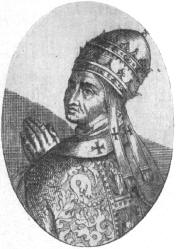
 Benedict
XI, born Nicholas Boccasini (Treviso,
1240 – July 7, 1304), pope (1303 - 1304),
succeeded the famous Boniface VIII, but was
unable to carry out his policies. Benedict was a
Dominican and when he was made Master General of
the order in 1296, he issued ordinances
forbidding public questioning of the legitimacy
of Boniface's election on the part of any
Dominican. At the time of the seizing of Pope
Boniface at Anagni, Boccasini was one of only
two cardinals to defend the papal party in the
Lateran Palace itself. However, upon being
elected pope, he released Philip the Fair of
France from the excommunication that had been
laid upon him by Boniface, and practically
ignored the bull Unam sanctam.
Nevertheless, on June 7, 1304, he excommunicated
Philip IV's implacable minister, William of
Nogaret, and all the Italians who had played a
part in the seizure of Boniface at Anagni.
Benedict
XI, born Nicholas Boccasini (Treviso,
1240 – July 7, 1304), pope (1303 - 1304),
succeeded the famous Boniface VIII, but was
unable to carry out his policies. Benedict was a
Dominican and when he was made Master General of
the order in 1296, he issued ordinances
forbidding public questioning of the legitimacy
of Boniface's election on the part of any
Dominican. At the time of the seizing of Pope
Boniface at Anagni, Boccasini was one of only
two cardinals to defend the papal party in the
Lateran Palace itself. However, upon being
elected pope, he released Philip the Fair of
France from the excommunication that had been
laid upon him by Boniface, and practically
ignored the bull Unam sanctam.
Nevertheless, on June 7, 1304, he excommunicated
Philip IV's implacable minister, William of
Nogaret, and all the Italians who had played a
part in the seizure of Boniface at Anagni.After a brief pontificate of eight months, Benedict died suddenly at Perugia. It was suspected, not altogether without reason, that his sudden death was caused by poisoning through the agency of Nogaret. Benedict's successor, Clement V, and the popes who succeeded him were completely under the influence of the kings of France, and removed the Papal seat from Rome to Avignon, thus inaugurating the period sometimes known as the Babylonian Captivity.
Benedict XI was the author of a volume of sermons and commentaries on the Gospel of Matthew, on the Psalms, the Book of Job, and John's Apocalypse.


